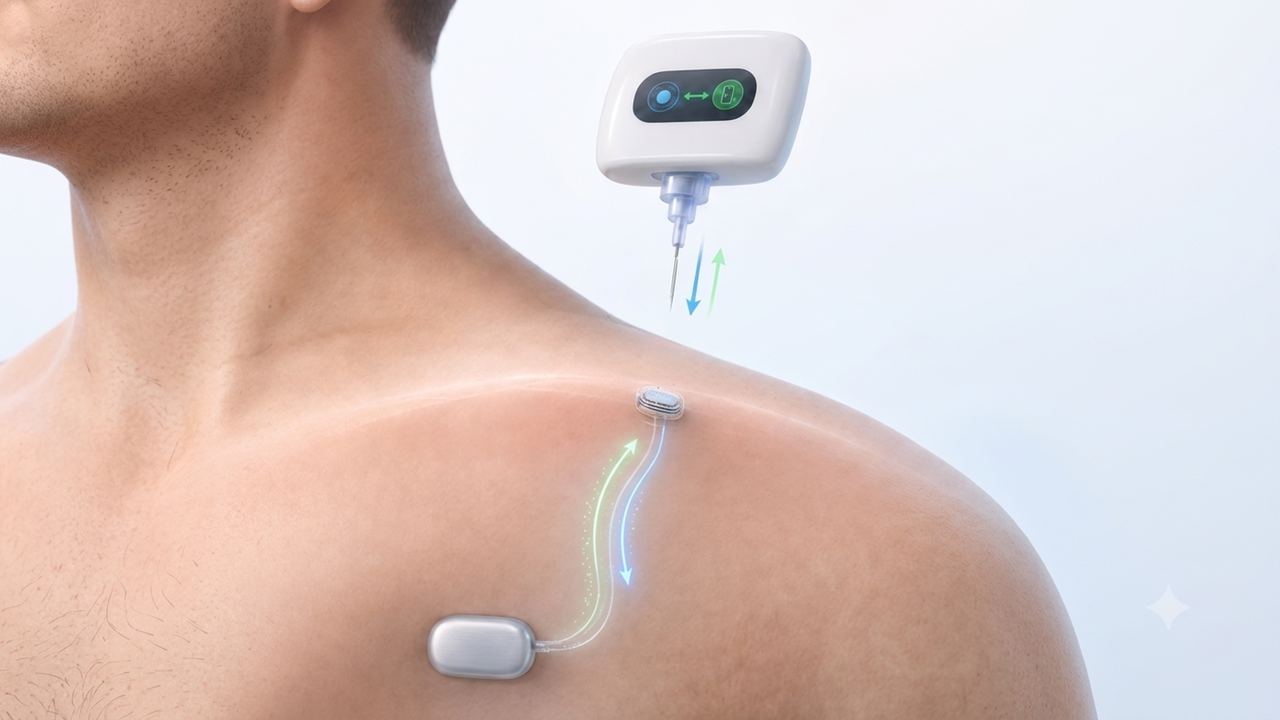
A USB plug for humans? Electricity outlet test delivers microwatts of power, but transfers data at 16Mbps
UC Irvine scientists develop hidden charging interface for long-term implanted medical devices Needle-access outlet powers implants without permanently exposing electrical connections Researchers achieve 16 Mbps data transfers via temporary implant-needle connections A persistent challenge in bioele
<![CDATA[ <article> <ul><li><strong>UC Irvine scientists develop hidden charging interface for long-term implanted medical devices</strong></li><li><strong>Needle-access outlet powers implants without permanently exposing electrical connections</strong></li><li><strong>Researchers achieve 16 Mbps data transfers via temporary implant-needle connections</strong></li></ul><p>A persistent challenge in bioelectronics is that exposed sockets invite microbial infection, while wireless charging antennas remain bulky.</p><p>Scientists at the <a href="https://engineering.uci.edu/news/2026/7/tissue-implant-bring-electricity-devices-inside-body" target="_blank" rel="nofollow">University of California, Irvine</a> have developed an implantable power outlet that remains beneath the skin and is accessed through a simple needle insertion.</p><p>Called the Implantable Bioelectronic Outlet (IBO), the device remains beneath the skin until electrical access is needed for charging, maintenance, or data retrieval. </p><h2 id="a-three-tier-memory-architecture-built-around-ssd-offloading">A three-tier memory architecture built around SSD offloading</h2><p>Researchers describe the implant as a general access point compatible with sensors, neural interfaces, stimulators, and battery-powered systems already used in medicine.</p><p>The device consists mostly of soft spongy plastic containing pores roughly 150 micrometers wide, comparable to a very fine needle's diameter.</p><p>The sponge was first dipped into a highly conductive polymer, coating its pores with a layer between 100 and 200 nanometers thick.</p><p>They then applied a silicone rubber solution to form a protective, electrically insulating jacket around the exterior surface.</p><p>Several jacketed sponge layers were sandwiched between unmodified sponge layers and covered entirely in silicone rubber to complete the module.</p><p>According to Hyung Joon Shim, a postdoctoral scholar in electrical engineering at UC Irvine, the device stays fully beneath the skin between uses.</p><p>A needle is inserted only when electrical access becomes necessary and is removed immediately afterward.</p><p>In tests on mice and rats, researchers coupled the outlets with neural interface implants to recharge batteries and transfer data.</p><p>Data transfer reached nearly 16 Mbps, matching the implants' maximum possible speed during these experimental sessions.</p><p>Separate pig experiments paired the outlets with stimulation implants, delivering 20-microampere electrical pulses lasting 100 milliseconds each over extended periods.</p><p>The porous structure resisted cracking after more than 100 needle insertions with gauges ranging from 18 to 30.</p><h2 id="moving-from-lab-results-to-real-world-applications">Moving from lab results to real-world applications</h2><p>The implanted outlets remained in the mice for over a year without degrading or causing visible complications.</p><p>Jennifer Gelinas, associate professor of pediatrics and anatomy and neurobiology at UC Irvine, said long-term safety is among the most critical requirements for any implantable technology.</p><p>Since test animals were anesthetized during charging sessions, real-world use in awake patients would require a different needle placement.</p><p>Gelinas suggested medical tape or an adhesive dressing, similar to methods used for standard intravenous needles, could stabilize the connection point.</p><p>Passing a needle through skin would likely cause brief discomfort comparable to a standard injection.</p><p>Future versions might incorporate smaller needles, topical anesthetics, or specialized coatings designed to reduce pain and inflammation during use.</p><p>Because the outlet needle would not require a hollow channel for fluid delivery, it could potentially be made thinner than conventional injection needles.</p><p>The scientists claim that this outlet could complement wireless technology, reserving needle access specifically for fast charging or large data transfers.</p><p>That said, the research team cautioned that evaluating pain, infection risk, and tissue response across repeated access sessions remains necessary before any patient testing begins.</p><figure class="van-image-figure inline-layout" data-bordeaux-image-check ><div class='image-full-width-wrapper'><div class='image-widthsetter' style="max-width:676px;"><p class="vanilla-image-block" style="padding-top:31.51%;"><img id="diM9tpwF2Lz85R8q85CT78" name="tr-g_news" alt="Google logo on a black background next to text reading 'Click to follow TechRadar'" src="https://cdn.mos.cms.futurecdn.net/diM9tpwF2Lz85R8q85CT78.jpg" mos="" align="middle" fullscreen="" width="676" height="213" attribution="" endorsement="" class="inline"></p></div></div></figure> </article> ]]>
Read the full article on TechRadar
Read Full Article →