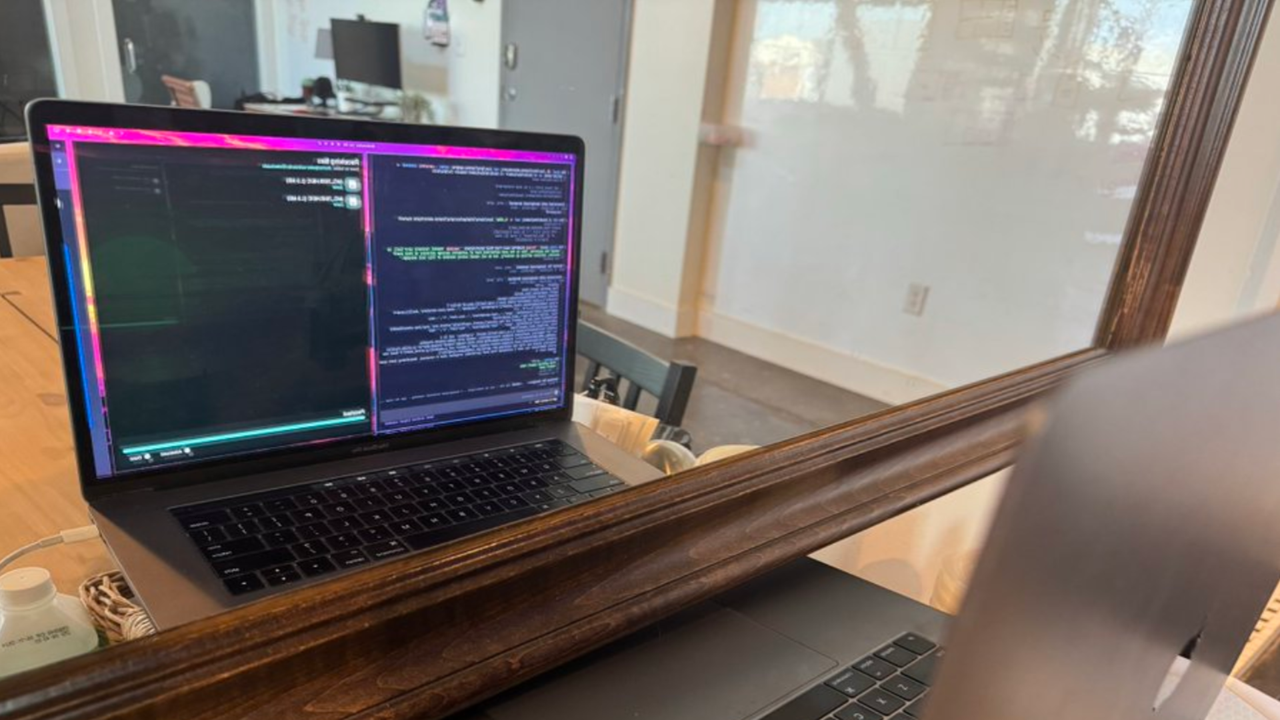
AI on Intel MacBook laptop uses webcam and mirror to rewrite and debug its own AMD Radeon driver code live and direct — without a programmer in the loop
A webcam and mirror replace human eyes during Radeon driver testing The laptop watches its own screen via a mirrored image Schroeder's setup targets AMD Radeon compatibility inside Omarchy Linux Justin Schroeder, a Linux developer, built an unusual setup pairing an older Intel MacBook with a mirror
<![CDATA[ <article> <ul><li><strong>A webcam and mirror replace human eyes during Radeon driver testing</strong></li><li><strong>The laptop watches its own screen via a mirrored image</strong></li><li><strong>Schroeder's setup targets AMD Radeon compatibility inside Omarchy Linux</strong></li></ul><p>Justin Schroeder, a Linux developer, built an unusual setup pairing an older Intel MacBook with a mirror and camera.</p><p>The setup uses the laptop's camera, a mirror, and its display to let the software inspect graphics changes without human checking during development.</p><p>This process was demonstrated while working on Omarchy, an open-source Linux distribution that is being adapted for Radeon graphics hardware.</p><h2 id="a-camera-becomes-the-agent-39-s-eyes">A camera becomes the agent's eyes</h2><p>The experiment turns the laptop's webcam into an unusual inspection tool by directing its view toward a mirror facing the display.</p><p>That reflected image gives the programming agent access to visual information about what happens after changes are made to graphics code.</p><p>Instead of relying entirely on textual output, the system can inspect visible rendering problems that appear directly on the laptop's screen.</p><p>Those problems can include distorted images, flickering displays, incorrect resolutions, or other changes that indicate graphics software is malfunctioning during testing.</p><p>The arrangement is unusual because the computer is effectively using its own camera to observe an image produced by itself.</p><p>Schroeder's demonstration concerns AMD Radeon support within Omarchy, where driver compatibility requires changes that can affect actual display output.</p><p>The camera and mirror therefore provide a physical feedback path between the software agent and the graphics hardware it is modifying during each test.</p><p>Schroeder <a href="https://x.com/jpschroeder/status/2097758256420565442" target="_blank" rel="nofollow">said</a> the agent could “see” the altered screen, giving its coding process information from direct visual feedback during testing.</p><h2 id="driver-changes-can-be-checked-through-the-display">Driver changes can be checked through the display</h2><p>Conventional graphics driver work normally requires programmers to alter code, compile it, restart relevant services, and inspect results manually.</p><p>The experiment instead gives the AI programming agent a way to inspect the outcome after modifying, rebuilding, and testing its graphics driver code.</p><p>This means visual verification can occur directly on the physical machine rather than depending only on compiler messages or textual diagnostics.</p><p>For Radeon support, that distinction matters because successful compilation does not necessarily mean the resulting graphics output will appear correctly.</p><p>A driver may build successfully while producing visible artifacts, unstable rendering, incorrect display settings, or other problems during actual operation.</p><p>The demonstrated workflow allows the agent to identify those visual changes and use them when deciding what code requires further adjustment.</p><p>It also allows repeated testing without requiring a programmer to inspect every intermediate result produced during the graphics development cycle.</p><p>Schroeder's experiment therefore connects automated programming with direct observation of hardware output, although the available demonstration does not establish how reliably this scales.</p><p>The setup also does not show that the agent independently created an entire production-ready Radeon driver without direct human involvement.</p><p>Instead, it shows a development method where an AI system can modify driver code and receive visual information from the resulting display.</p><p>That distinction is important because driver development involves many functions that cannot be evaluated solely through what appears on one screen</p><figure class="van-image-figure inline-layout" data-bordeaux-image-check ><div class='image-full-width-wrapper'><div class='image-widthsetter' style="max-width:676px;"><p class="vanilla-image-block" style="padding-top:31.51%;"><img id="diM9tpwF2Lz85R8q85CT78" name="tr-g_news" alt="Google logo on a black background next to text reading 'Click to follow TechRadar'" src="https://cdn.mos.cms.futurecdn.net/diM9tpwF2Lz85R8q85CT78-1920-80.jpg" mos="" align="middle" fullscreen="" width="676" height="213" attribution="" endorsement="" class="inline"></p></div></div></figure> </article> ]]>
Read the full article on TechRadar
Read Full Article →