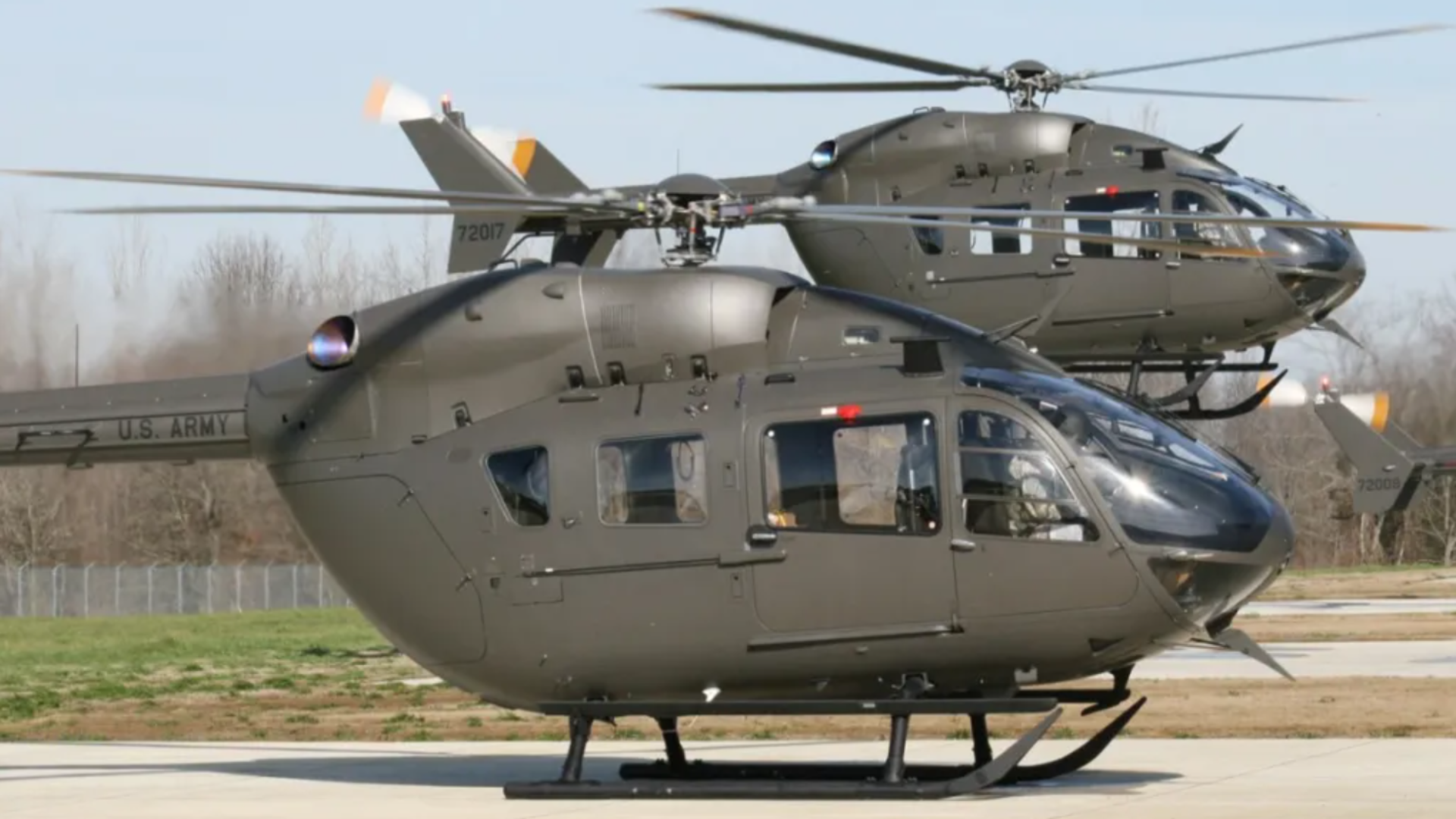
'Autonomously commanded from up to 70 miles away': The US military is testing self-flying cargo helicopters that navigate around sudden no-fly zones on their own
Airbus’ MQ-72C rerouted itself after restricted airspace suddenly appeared during flight Starlink carried remote commands to a cargo helicopter from 70 miles away Shield AI’s Hivemind software helps helicopters navigate without constant pilot intervention The US Army has tested Airbus’ MQ-72C Lakota
<![CDATA[ <article> <ul><li><strong>Airbus’ MQ-72C rerouted itself after restricted airspace suddenly appeared during flight</strong></li><li><strong>Starlink carried remote commands to a cargo helicopter from 70 miles away</strong></li><li><strong>Shield AI’s Hivemind software helps helicopters navigate without constant pilot intervention</strong></li></ul><p>The US Army has tested Airbus’ MQ-72C Lakota Connector, an autonomous cargo helicopter designed to reroute around suddenly restricted airspace.</p><p>Operators controlled the helicopter from distances reaching 70 miles through communications infrastructure supporting operations beyond conventional line of sight.</p><p>The aircraft follows a flight plan supplied by a human operator, while onboard autonomy software handles navigation and responses to changing conditions.</p><h2 id="starlink-and-hivemind-enable-remote-control-and-autonomous-navigation">Starlink and Hivemind enable remote control and autonomous navigation</h2><p>Airbus conducted five demonstration flights at Huntsville Executive Airport in Alabama, showcasing autonomous hovering, complex turns, and conventional airport traffic patterns.</p><p>During one exercise, the aircraft encountered a newly introduced restricted airspace area and calculated an alternative route using its onboard autonomy systems.</p><p>“The aircraft had to autonomously make decisions about how it was going to route itself around the no-fly zones,” said Jaysen Yochim, Airbus’ senior director for the Aerial Logistics Connector programme.</p><p>A pilot remained aboard for safety during these trials, although Yochim said the individual never needed to assume control.</p><p>The helicopter’s autonomy depends partly on Shield AI’s Hivemind software, which interprets imagery collected by onboard sensors.</p><p>Two LiDAR sensors, facing forward and backward, work alongside a nose-mounted electro-optical camera to supply environmental information for navigation decisions.</p><p>Remote command relies on a separate communications layer, with SpaceX’s Starlink satellite network carrying instructions between ground control stations and the aircraft.</p><p>Airbus has already tested this arrangement beyond conventional line of sight, enabling human operators to issue commands from far distances.</p><p>We’ve had flights that have been autonomously commanded from up to 70 miles away. All of that is stuff that’s happened in the last year,” Yochim added.</p><p>“We also have where the aircraft can be commanded from both a ground control station like this and also with the Samsung tablet.”</p><h2 id="cargo-conversion-and-military-adoption-remain-unfinished">Cargo conversion and military adoption remain unfinished</h2><p>Airbus based the MQ 72C on its UH 72B Lakota, derived from the H145, but additional modifications remain necessary for cargo operations.</p><p>Front-mounted clamshell doors would create a passage through the cabin, allowing crews to load and unload supplies more quickly.</p><p>Although Airbus has completed initial design work and preliminary testing, flight and wind tunnel tests remain outstanding. The company expects to install the doors around 2029 or 2030.</p><p>The Army also needs better ways to supply troops following long-distance air assaults involving future MV 75A tiltrotors.</p><p>Major General David Gardner, head of the 101st Airborne Division, explained the challenge of transporting heavy equipment across hundreds of miles.</p><p>“We can put some things inside the helicopter, and we can put some things under a helicopter with a sling load. We’re not going to sling load something moving 250-ish knots for 500 miles. We’re not going to hang Humvees under that,” said Gardner.</p><p>Other contenders for autonomous military cargo delivery include the AW139, Black Hawk, Robinson R66 and Bell 505.</p><p>The Army has not announced a procurement requirement, although its interest in Airbus’ demonstration suggests autonomous cargo delivery is receiving attention.</p><figure class="van-image-figure inline-layout" data-bordeaux-image-check ><div class='image-full-width-wrapper'><div class='image-widthsetter' style="max-width:676px;"><p class="vanilla-image-block" style="padding-top:31.51%;"><img id="diM9tpwF2Lz85R8q85CT78" name="tr-g_news" alt="Google logo on a black background next to text reading 'Click to follow TechRadar'" src="https://cdn.mos.cms.futurecdn.net/diM9tpwF2Lz85R8q85CT78-1920-80.jpg" mos="" align="middle" fullscreen="" width="676" height="213" attribution="" endorsement="" class="inline"></p></div></div></figure> </article> ]]>