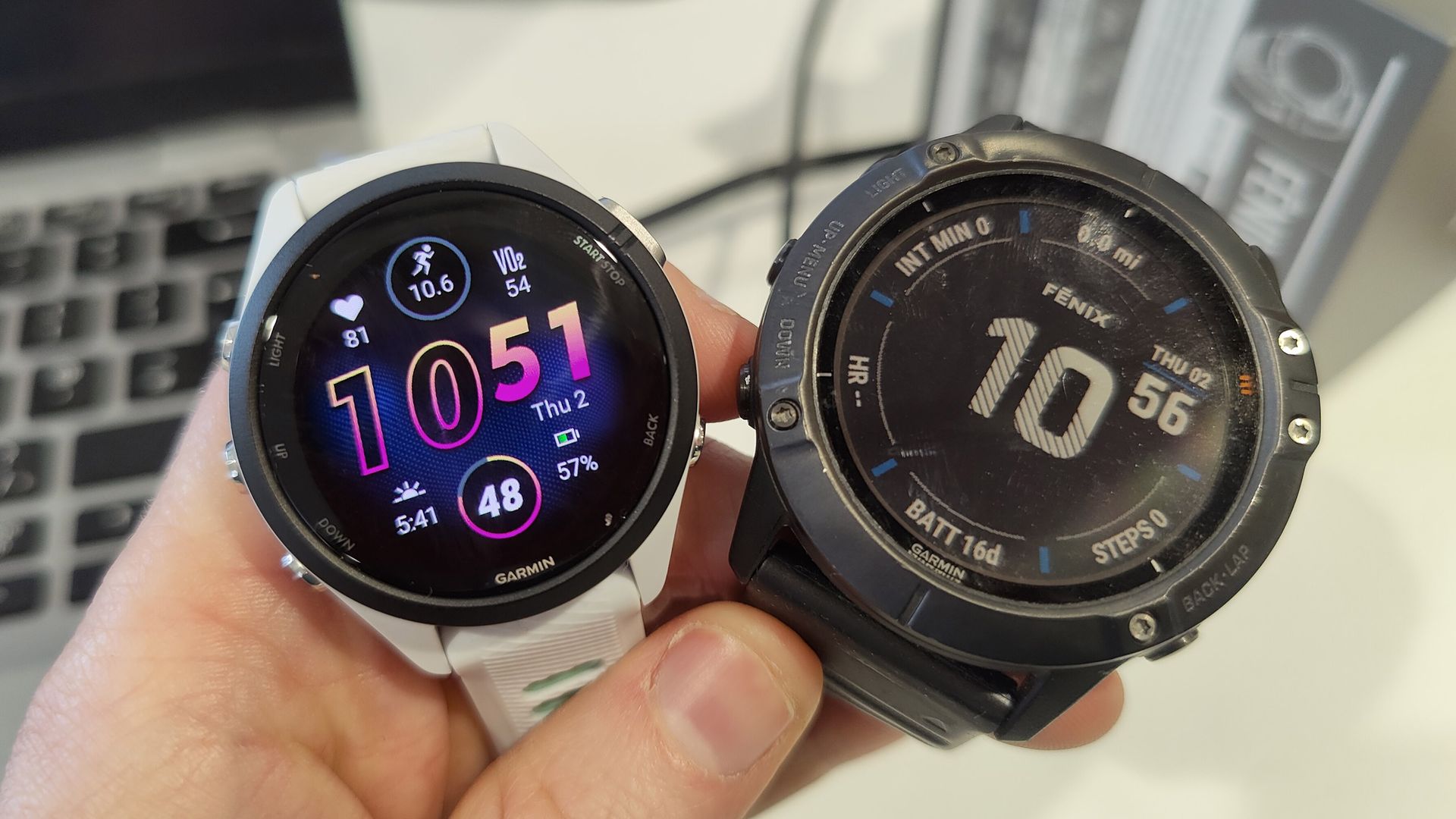
Garmin may use a smart solar trick to lift its AMOLED watches’ battery life
Garmin is working on a new way to boost its AMOLED watches’ battery life The idea involves placing solar cells between screen pixels This wouldn’t dull the display, as some solar techs do Check our list of the best Garmin watches and you’ll find a mixture of AMOLED and MIP screens , because as beaut
<![CDATA[ Garmin is working on a new way to boost its AMOLED watches’ battery life The idea involves placing solar cells between screen pixels This wouldn’t dull the display, as some solar techs do Check our list of the best Garmin watches and you’ll find a mixture of AMOLED and MIP screens , because as beautiful as an OLED display can look, it can’t hold a candle to MIP’s battery life. But that could soon change, as Garmin appears to be researching a clever new way to give OLED watch faces a significant battery boost. A recently published patent (number 20260362887 ) shows that Garmin is looking into ways of nestling miniature solar cells between the pixels of its AMOLED screens. That means you’d get a way to juice up your watch — albeit quite slowly — while you’re out and about, with no need to stop and find a charging point. The benefit of this goes beyond battery life. Because the solar cells would be effectively interlaced into the display, it would forgo the need for a complete solar layer covering the display. Normally, these layers can have a dimming effect on a watch’s screen, so without that, your AMOLED Garmin watch could look crisper and clearer. It would also avoid the need to place a solar ring around the display, which some watches use to add solar charging. While this doesn’t dull the screen contents, it can either result in a larger watch or eat into the available display space, neither of which might be ideal solutions. An all-AMOLED future The Garmin Instinct Crossover AMOLED (Image credit: Garmin) The timing of this patent publication is interesting, as just a few weeks ago we spoke to Brad Trenkle , chief operating officer (COO) at Garmin, about the battery differences between OLED and MIP screens used in the company’s watches. And in that interview, Trenkle made it clear that the difference between the two techs will continue to be reduced. Speaking at the time, Trenkle said that the gap has “closed a lot, which is why you’ve seen battery life on our OLED products continue to increase generation over generation.” However, the COO added that “that gap has not completely converged, and I think until it does, we definitely don’t think that MIP will completely go away.” Yet Trenkle hinted that something like what’s described in the patent could be part of Garmin’s future. Asked whether in-screen solar will always dull an AMOLED display, Trenkle responded: “From purpose of a thought experiment, not really.” Trenkle didn’t come out and say that Garmin was working on inter-pixel solar cells and instead suggested that a ring around the watch face could house solar units. But it’s clear that the COO didn’t think that solar tech has to necessarily degrade the viewing experience. Perhaps this patent could be part of the future Trenkle envisioned, if it ever makes it into a finished product. If Garmin can make it work, it might just eliminate one advantage that MIP has over OLED screens — and move us closer to an all-AMOLED future for Garmin fans. ]]>
Read the full article on TechRadar
Read Full Article →