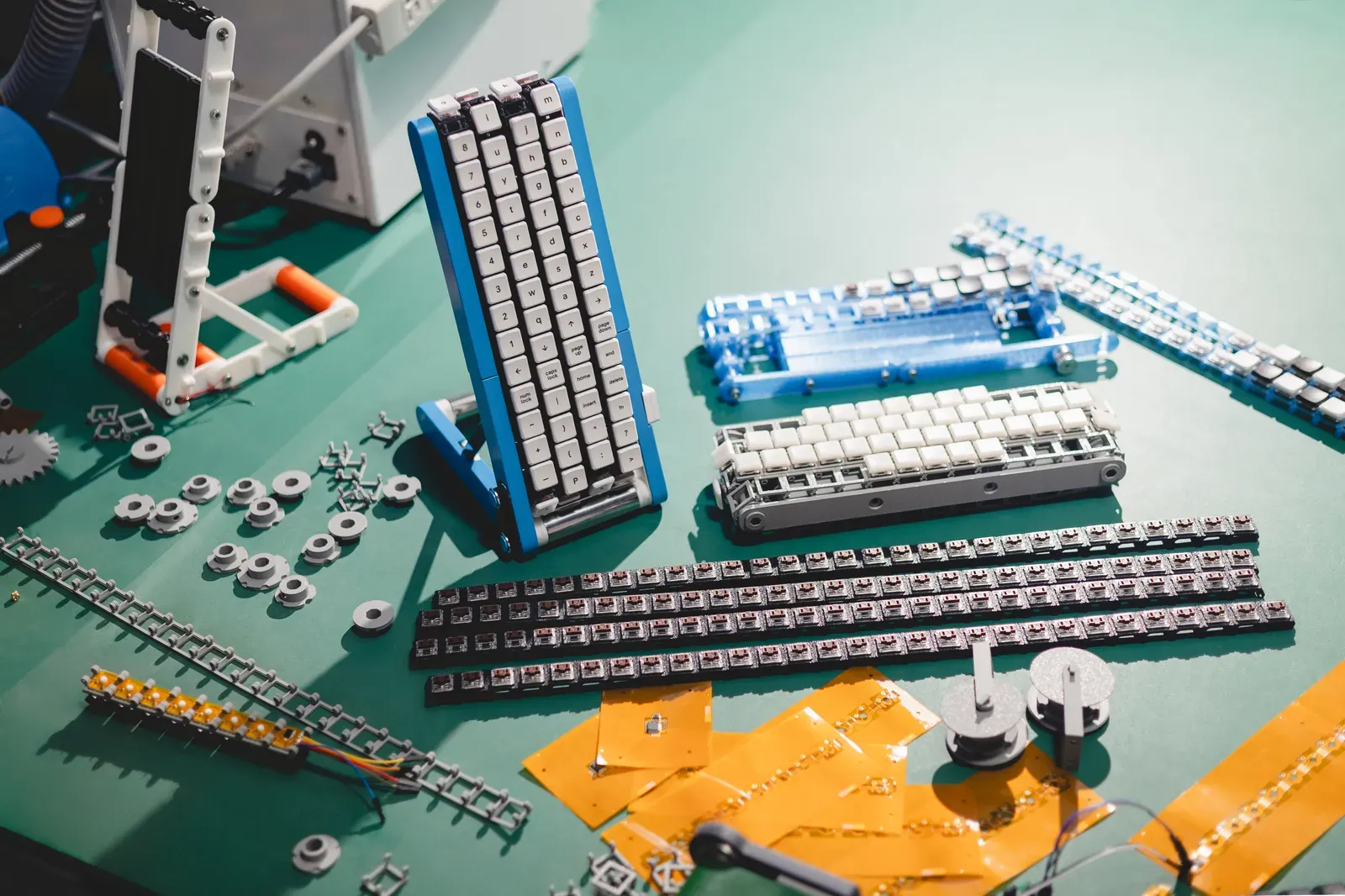
Google shows off a whole new type of keyboard — and it says having keys rolling on a conveyor belt will make typing easier for all
Google Japan's Gboard team unveiled a DIY conveyor-belt keyboard featuring 116 keys on four looping belts that move towards your hand Google pitches it at one-handed and one-finger typing, not "for all," and it is the 15th entry in a deliberately absurd series that began as April Fools' gags in 2010
<![CDATA[ <article> <ul><li><strong>Google Japan's Gboard team unveiled a DIY conveyor-belt keyboard featuring 116 keys on four looping belts that move towards your hand</strong></li><li><strong>Google pitches it at one-handed and one-finger typing, not "for all," and it is the 15th entry in a deliberately absurd series that began as April Fools' gags in 2010</strong></li><li><strong>The design files are open source on GitHub, but only the motorized "Moving Keys" edition is documented, while the typing-capable Bluetooth edition and its board files are still marked as "coming soon."</strong></li></ul><p>Google Japan's Gboard team has <a href="https://blog.google/intl/ja-jp/products/android-chrome-play/gboard-2026/" target="_blank" rel="nofollow">unveiled the Gboard Conveyor Belt Version</a>, a desktop contraption that mounts its keys on four looping belts so that characters scroll past a waiting fingertip.</p><p>Its Japanese name, the Gboard kurukuru version, means something like "round and round," with a nod to the word <em>kuru</em>, which roughly translates as "to approach/arrive".</p><p>Google has no plans to market or sell the unique contraption, but it has <a href="https://github.com/google/mozc-devices/tree/main/mozc-conveyorbelt" target="_blank" rel="nofollow">published the design files on GitHub</a> under an Apache 2.0 license for anyone with a 3D printer and plenty of patience.</p><h2 id="flipping-the-script-bringing-the-keys-to-your-finger">Flipping the script: bringing the keys to your finger</h2><p>The intriguing pitch, set out in Google's <a href="https://blog.google/intl/ja-jp/products/android-chrome-play/gboard-2026/" target="_blank" rel="nofollow">Japanese-language announcement</a>, starts from a fair observation: Conventional keyboards assume two hands, so typing with one hand or a single finger means hauling your arm and palm across the deck. </p><p>Google's answer, in its own words (translated), aims to flip the script completely: "The keyboard should be the one that moves." It calls this a "Copernican turn" (translated) that puts the typist at the center of text input, an interesting borrowing from an astronomer better known for removing humanity from the center of things.</p><p>Each of the four belts carries 29 keys, for a total of 116, and you press the character you want as it flows past. More interestingly, uppercase and lowercase letters get their own keys, so capitals don't need Shift, which Google says makes the whole thing intuitive.</p><div class="youtube-video" data-nosnippet ><div class="video-aspect-box"><iframe data-lazy-priority="high" data-lazy-src="https://www.youtube-nocookie.com/embed/DAn34l_YrUM" allowfullscreen></iframe></div></div><p> The blog suggests typing one-handed while sipping tea or using a mouse with the other hand, then adds that a second unit would allow two-handed operation, which, ironically, brings us neatly back to where keyboards started.</p><p>Google bills the conveyor belt as the 15th entry in its series of new keyboard proposals, which the project's <a href="https://github.com/google/mozc-devices/blob/main/README.md" target="_blank" rel="nofollow">GitHub index</a> traces to a drum-kit input system released on April 1, 2010.</p><p>The early entries were somewhat ironically a different niche altogether: they served as April Fools' gags. After a pause in 2020, the series returned on October 1, 2021, a date Google picked as a nod to the 101-key keyboard, and it has stuck around since.</p><p>When asked why the team left April Fools' Day behind, a Google spokesperson told <a href="https://ascii.jp/elem/000/004/422/4422857/" target="_blank" rel="nofollow">ASCII.jp</a> it was "because we realized we weren't actually lying" (translated). Recent years have produced a bar keyboard with every key in a single row, a keyboard worn as a hat, a double-sided board, and last year's rotary dial.</p><p>Google's blog bills this as a DIY keyboard you can actually build, and its README lists KiCad schematics, PCB layouts, and firmware among the files. Still, it would be an uphill task for most people, since having a 3D printer is but the start of what will inevitably be a long journey.</p><p>The complexity and the effort required don't make the project any less delightful. Whether typing on it is easy, however, remains to be seen, even if it clearly wins some accessibility points thanks to its design.</p> </article> ]]>
Read the full article on TechRadar
Read Full Article →