'I worked for like 15 years on just Hearts of Iron and history, so you want to do something different' — Afterworld director explains the fantasy post-apocalyptic setting, and the pub trip that inspired the game
Afterworld is the first Paradox grand strategy game with an original fantasy setting in a decade Director Dan Lind says this brings a level of "design freedom" that would be possible in few real-world settings He also wanted "to do something different" after working on historical games for so long T
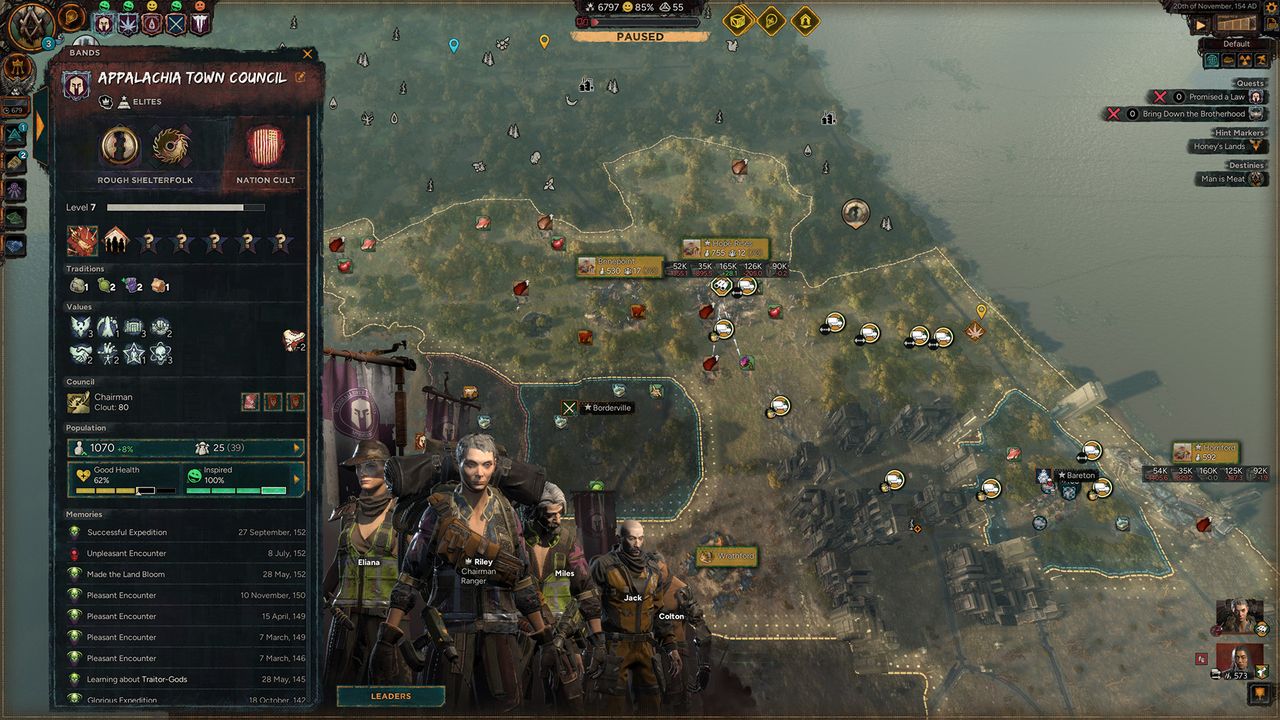
<![CDATA[ <article> <ul><li><em><strong>Afterworld </strong></em><strong>is the first Paradox grand strategy game with an original fantasy setting in a decade</strong></li><li><strong>Director Dan Lind says this brings a level of "design freedom" that would be possible in few real-world settings</strong></li><li><strong>He also wanted "to do something different" after working on historical games for so long</strong></li></ul><p>The recently revealed <a href="https://www.techradar.com/gaming/gaming-industry/the-studio-behind-crusader-kings-and-hearts-of-iron-just-revealed-its-first-non-historical-title-in-a-decade-afterworld-is-a-new-strategy-game-set-in-an-original-post-apocalyptic-america"><em>Afterworld </em></a>stands apart from the rest of the recent Paradox Games portfolio. It's the studio's first title in a decade to take place in an original fictional setting, this time post-apocalyptic North America, rather than a real-world historical one.</p><p>The game is being directed by studio veteran Dan Lind, who has been working at Paradox for almost twenty years. He started out on <em>Europa Universalis 3</em>, working his way up to eventually become game director of the supremely popular <em>Hearts of Iron 4 </em>— a massive-scale WW2 sim.</p><p>In an interview with TechRadar Gaming at the company's Stockholm HQ, Lind explained that not being tied down by history allows for a whole new level of "design freedom."</p><p>"I worked for like 15 years on just <em>Hearts of Iron </em>and history, so you want to do something different," he said. "That was a big motivator."</p><p>He also thinks that <em>Afterworld</em>, which features a map based on just part of one country rather than a chunk of the globe, will be able to fill a specific niche in Paradox's offering. </p><p>"Looking at our games, I think there's a niche in between a couple of them that we're not tapping," he explained. </p><p>"I think there's another different, fresh grand strategy game experience that you can have at a bit of a smaller scale, but with more detail basically. Also having worked with 'crunchy' games such as <em>Hearts of Iron</em>, I wanted to see if we could find a way to make the game easier for people to get into."</p><p>He continued: "It's kind of a bit 4X like this, and you can start scaling the mechanics over time. It makes it so much easier, right? It's hard to do that with a historical setting, unless you're doing something like a migration era, but this game can also tap a lot of those ideas."</p><figure class="van-image-figure inline-layout" data-bordeaux-image-check ><div class='image-full-width-wrapper'><div class='image-widthsetter' style="max-width:2560px;"><p class="vanilla-image-block" style="padding-top:56.25%;"><img id="5VsgDGdniLrGQUUYSnHt28" name="IMG_20260814_095653" alt="The Paradox Interactive office in Stockholm." src="https://cdn.mos.cms.futurecdn.net/5VsgDGdniLrGQUUYSnHt28.jpg" mos="" align="middle" fullscreen="" width="2560" height="1440" attribution="" endorsement="" class="inline"></p></div></div><figcaption itemprop="caption description" class=" inline-layout"><span class="caption-text">The company's current office in central Stockholm. </span><span class="credit" itemprop="copyrightHolder">(Image credit: Future)</span></figcaption></figure><p>He also revealed the surprising origin of his pitch for the game, which he's wanted to bring to life for over two decades.</p><p>"I think the first draft for this was super long ago. I'm not sure; it might have been like 2011 or something," he began. "We used to do these brainstorms at the pub, where the idea was to just come up with a bunch of games."</p><p>The team would sift through all of them at the end of the night, deciding which were "a terrible idea" and which were "actually an interesting idea."</p><p>"This was a good idea. I had one that was playing DNA chains through primordial soup, which we rejected, but this one was something that was pretty cool.</p><p>"I've always believed that you could do grand strategy games at slightly different scales. It doesn't always have to be big; the entire world. It can be just as interesting, but you've got to add details in the other direction as well.</p><p>At that point, it was a different scale. It was even smaller; I would say it was maybe the size of three states or something like that. When I was working on <em>Hearts of Iron</em> and a bunch of other stuff, I always had this in the back pocket as something I wanted to try and get back to."</p><p>Naturally, the idea evolved over time as Lind became "more and more interested in things that were...less board game, more simulation," leading to the current scale and focus on <a href="https://www.techradar.com/gaming/pc-gaming/director-says-afterworld-has-some-of-the-deepest-simulation-of-any-paradox-strategy-game-the-idea-is-to-drip-feed-you-until-youre-hooked">deep societal simulation</a>.</p><p>"Now I'm shifting it more to groups of people, but not country level."</p><p><em>Afterworld </em>is set to launch for PC in the future.</p> </article> ]]>