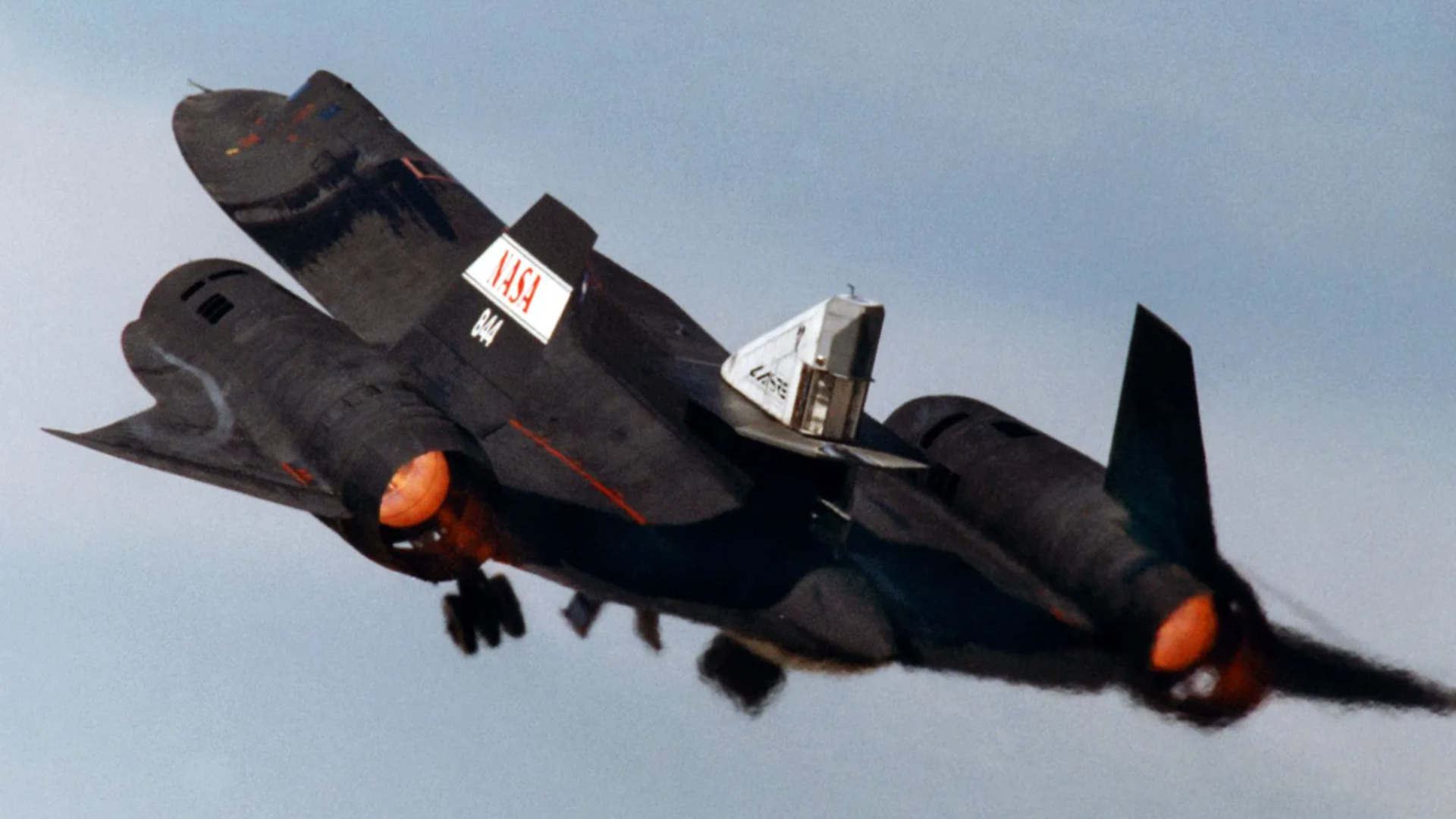
NASA could bring back SR-71 as missing Blackbird sparks wild speculation about the world's fastest plane ever and former staffers contacted for 'help'
NASA's SR-71 Blackbird has vanished from its outdoor display pole Satellite imagery shows the Blackbird was gone by mid-May 2026, or possibly April Retired engineers Mike Relja and Tim Conners declined NASA's offer to help fly the Blackbird A Lockheed SR-71 Blackbird with tail number 844 has vanishe
<![CDATA[ <article> <ul><li><strong>NASA's SR-71 Blackbird has vanished from its outdoor display pole</strong></li><li><strong>Satellite imagery shows the Blackbird was gone by mid-May 2026, or possibly April</strong></li><li><strong>Retired engineers Mike Relja and Tim Conners declined NASA's offer to help fly the Blackbird</strong></li></ul><p>A Lockheed SR-71 Blackbird with tail number 844 has vanished from the outdoor exhibit at NASA's Armstrong Flight Research Center, prompting questions about the agency's plans.</p><p>Satellite imagery obtained by Aviation Week shows the aircraft had left its pole by the middle of May 2026, and possibly even as early as April.</p><p>The aircraft left its pole months before Jared Isaacman, NASA's administrator, showed a silhouette resembling the Blackbird at the All-In Summit in Los Angeles in September.</p><h2 id="former-engineers-say-nasa-asked-for-help">Former engineers say NASA asked for help</h2><p>Retired test engineer Mike Relja, now well into his seventies, said NASA offered him work roughly four weeks ago on returning the aircraft to flight, but he declined.</p><p>David Ash, a onetime Navy pilot who joined NASA in June to direct special projects, made the request but never explained the agency's motives.</p><p>“I told the guy, ‘You know, I’m too old to be doing this,’” Relja told <a href="https://aviationweek.com/defense/aircraft-propulsion/nasa-asked-several-former-sr-71a-staffers-help-secret-restart" target="_blank" rel="nofollow">Aviation Week</a>. “I wish you well. I’d like to see you make it. It would be interesting. But I just don’t think you can get there from here.”</p><p>The airframe is 59 years old, and last flew on October 9, 1999 leaving a gap of almost 27 years and a long list of challenges.</p><p>Whoever takes this job should expect engines left idle for decades, cavities holding moisture and grit, and no spares after the $600 million stock was destroyed in 2007.</p><p>JP-7 fuel, triethylborane, hydraulic fluids and specialised ground carts would also need restoring, Relja said, and the last JP-7 stocks were burned in 2002.</p><p>NASA has not confirmed any plan to fly the aircraft again, and a spokesperson declined to explain why it was taken off its pole.</p><p>A similar offer was made to Tim Conners, a retired NASA test engineer, but he too declined the offer - however, he suggested that museum aircraft could supply spares, since nine Blackbirds reached exhibits with engines.</p><p>“My first thought was, ‘My god, I would drop everything [to help] …My second thought was, ‘How in the world are they going to do it? Those subsystems could be cannibalized,” said Tim Conners.</p><p>“The architecture was as simple as they could make it…It’s a big deal, but it should not be a showstopper…compared to some of the other challenges.”</p><h2 id="why-nasa-might-want-the-aircraft">Why NASA might want the aircraft</h2><p>When asked about the silhouette at a press conference, Jared Isaacman said, "You sure that's a Blackbird?" and didn’t clarify anything.</p><p>At the EAA AirVenture in July, journalists asked him whether he had authority to revive such an old aircraft, and his response was "That's classified."</p><p>The SR-71 cruised near Mach 3.2 at almost 85,000 feet, and NASA flew Blackbirds in the 1990s for research on propulsion, structures and sonic booms.</p><p>The Aviationist notes that no aircraft currently used by NASA can reproduce that combination of speed and altitude.</p><p>The Blackbird could also serve as a stepping stone between supersonic testing and hypersonic flight, or as a carrier for experimental vehicles, though the latter would need modifications.</p><p>Reviving a long-retired aircraft isn't unheard of, either. The F-117 left service in 2008, yet it still flies regularly for training and testing nearly two decades later.</p><p>The estimate for reactivating an SR-71 for intelligence missions, made about two years after the final flight, reached $40 million to $45 million.</p><p>Adjusting for inflation alone, that estimate would be roughly $75 million to $85 million today. The real cost would likely run higher given the need to rebuild the supply chains, spare parts, and trained crews. </p><figure class="van-image-figure inline-layout" data-bordeaux-image-check ><div class='image-full-width-wrapper'><div class='image-widthsetter' style="max-width:676px;"><p class="vanilla-image-block" style="padding-top:31.51%;"><img id="diM9tpwF2Lz85R8q85CT78" name="tr-g_news" alt="Google logo on a black background next to text reading 'Click to follow TechRadar'" src="https://cdn.mos.cms.futurecdn.net/diM9tpwF2Lz85R8q85CT78-1920-80.jpg" mos="" align="middle" fullscreen="" width="676" height="213" attribution="" endorsement="" class="inline"></p></div></div></figure> </article> ]]>
Read the full article on TechRadar
Read Full Article →