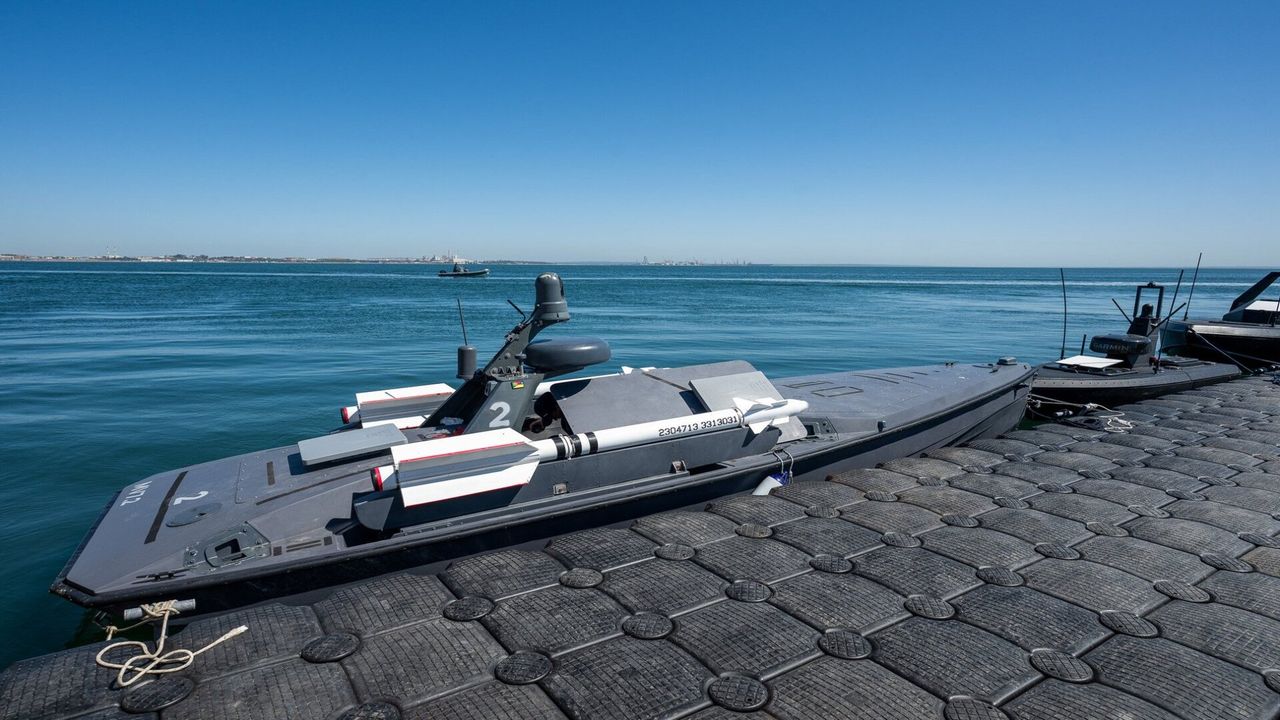
Pentagon launches campaign for unmanned boats able to launch drones at sea
The Pentagon seeks autonomous boats capable of launching drones during maritime operations Competition offers $100 million before potential $200 million procurement contracts Three testing sprints will evaluate operational readiness before procurement decisions The Pentagon has released a formal sol
<![CDATA[ <article> <ul><li><strong>The Pentagon seeks autonomous boats capable of launching drones during maritime operations</strong></li><li><strong>Competition offers $100 million before potential $200 million procurement contracts</strong></li><li><strong>Three testing sprints will evaluate operational readiness before procurement decisions</strong></li></ul><p>The Pentagon has released a formal solicitation seeking an unmanned surface vessel capable of launching small attack drones directly at sea.</p><p>The Defense Innovation Unit outlined the detailed requirements under a project officially called Suitable Warfighting Adaptive Payloads (SWAP-USV).</p><p>This competition aims to strengthen asymmetric capabilities against low-cost maritime threats operating across contested waters.</p><h2 id="a-year-long-competition-with-major-funding">A year-long competition with major funding</h2><p>The Pentagon is launching a year-long, multi-phase competition backed by roughly $100 million in total prize funding.</p><p>This contest will consist of three separate testing sprints, each carrying its own distinct rewards and specific technical requirements for participants.</p><p>Companies that complete each testing phase will become eligible for procurement contracts supported by an additional $200 million budget.</p><p>Sprint 1 begins in-water testing in the fall of 2026, aiming to reach full field deployment within 120 days afterward.</p><p>The competition then continues into early 2027 with Sprint 2, which will focus specifically on expanded payload capacity for surviving entrants.</p><p>It ultimately concludes with Sprint 3, scheduled for summer 2027, marking the entire program's final and decisive phase of evaluation.</p><p>The Pentagon is actively inviting participation from maritime manufacturers, autonomy developers, sensor specialists, and established drone companies across the defense sector.</p><p>Firms may choose to enter whichever phase of the competition best matches their existing technical capabilities and current development timeline.</p><h2 id="strict-technical-requirements-for-the-winning-vessel">Strict technical requirements for the winning vessel</h2><p>The unmanned vessel must operate reliably across blue-water, littoral, and other varied maritime environments without requiring constant direct human oversight.</p><p>It needs onboard sensors capable of detecting and tracking surface targets while patrolling assigned areas or navigating toward designated waypoints autonomously.</p><p>At minimum, the vessel must achieve an operational range of 200 nautical miles, equivalent to roughly 370 kilometers, or 230 miles.</p><p>It must also maintain sustained cruising speeds reaching 10 knots, which translates to approximately 19 kilometers, or 12 miles per hour.</p><p>The vessel is expected to deploy cost-effective <a href="https://www.techradar.com/cameras/drones/best-drone">drones</a> directly from onboard launch systems, expanding its operational mission profile at sea.</p><p>Those aerial systems would additionally support secondary missions such as electronic warfare operations and communications relay across contested or denied environments.</p><p>The solicitation explicitly frames this vessel as mature and market-ready hardware, rather than experimental technology requiring years of additional development work.</p><p>This suggests the Pentagon wants existing commercial maritime technology adapted quickly, rather than funding entirely new engineering efforts from scratch.</p><p>In recent times, drone boats have been incredibly useful in war. Recall that when the US Army Apache helicopter <a href="https://www.techradar.com/pro/a-us-army-apache-helicopter-went-down-near-the-strait-of-hormuz-an-uncrewed-drone-boat-made-history-by-saving-its-crew">went down near the Strait of Hormuz, it was an uncrewed drone boat that saved its crew</a>. </p><p>The <a href="https://www.techradar.com/pro/uk-tests-robot-boat-that-can-fly-its-own-wired-drone-even-in-14ft-waves-and-stay-at-sea-for-weeks">UK is working on drone boats that can fly</a> while Ukraine has been at the<a href="https://www.techradar.com/pro/ukraine-confirms-it-will-produce-10-million-drones-in-2026-rising-to-20-million-as-it-signs-a-massive-usd1-1-billion-drone-deal-with-the-eu"> forefront of drone technology</a>. It is therefore reasonable for the U.S. to invest in drone boat technology. </p><p>Via <a href="https://dronefront.com/pentagon-usv-deploy-drones/" target="_blank" rel="nofollow">The DroneFront</a></p><figure class="van-image-figure inline-layout" data-bordeaux-image-check ><div class='image-full-width-wrapper'><div class='image-widthsetter' style="max-width:676px;"><p class="vanilla-image-block" style="padding-top:31.51%;"><img id="diM9tpwF2Lz85R8q85CT78" name="tr-g_news" alt="Google logo on a black background next to text reading 'Click to follow TechRadar'" src="https://cdn.mos.cms.futurecdn.net/diM9tpwF2Lz85R8q85CT78.jpg" mos="" align="middle" fullscreen="" width="676" height="213" attribution="" endorsement="" class="inline"></p></div></div></figure> </article> ]]>
Read the full article on TechRadar
Read Full Article →