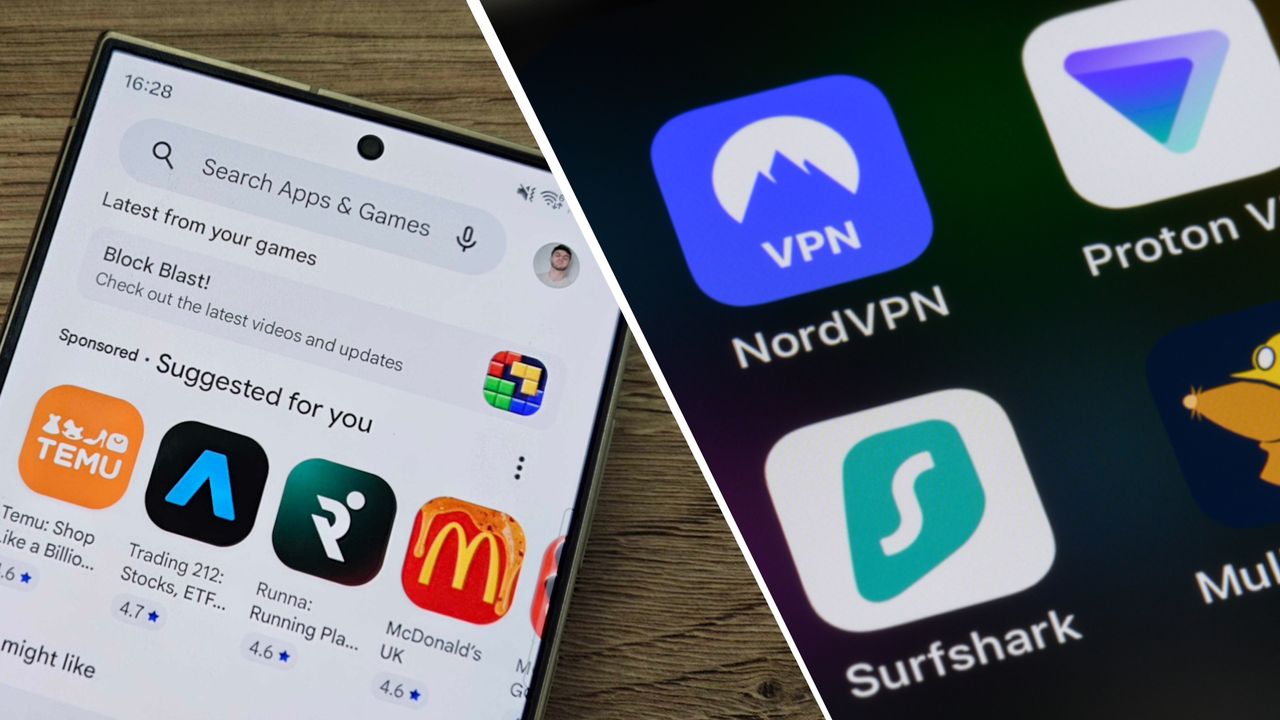
Thousands of iOS and Android VPNs are hiding behind fake websites and useless privacy policies — here's how to spot them
If you think downloading a VPN directly from an official app store guarantees your digital privacy, it’s time to think again.
<![CDATA[ <article> <p>If you think downloading a VPN directly from an official app store guarantees your digital privacy, it’s time to think again.</p><p>We recently undertook a huge audit of storefront verification standards, which has exposed a severe lack of quality control across both the iOS App Store and Google Play. </p><p>We evaluated developer transparency and store verification standards, analyzing 3,392 Android VPN apps (with more than 1,000 downloads) and 1,387 iOS VPN apps (with at least one review).</p><p>It appears that Google Play looks significantly worse than Apple's App Store across almost every transparency and validity metric. In fact, a mere <strong>61.4% (851)</strong> of iOS apps passed all main validity checks, while Android trailed far behind with just <strong>40.8% (1,210)</strong> passing the same tests.</p><p>Just because a VPN is available on an official App Store doesn’t mean it’s legitimate. Here is what the data tells us about the safety of mobile VPNs.</p><h2 id="storefront-enforcement-quality-control-data">Storefront Enforcement & Quality Control Data</h2><figure class="van-image-figure inline-layout" data-bordeaux-image-check ><div class='image-full-width-wrapper'><div class='image-widthsetter' style="max-width:970px;"><p class="vanilla-image-block" style="padding-top:56.29%;"><img id="i3aChsQf5uh5SVACMnkMM" name="google-play-store.jpg" alt="Google Play Store" src="https://cdn.mos.cms.futurecdn.net/i3aChsQf5uh5SVACMnkMM.jpg" mos="" align="middle" fullscreen="" width="970" height="546" attribution="" endorsement="" class="inline"></p></div></div><figcaption itemprop="caption description" class=" inline-layout"><span class="credit" itemprop="copyrightHolder">(Image credit: Google)</span></figcaption></figure><p>When you hand over your web traffic to a VPN, you expect the developer to be a real, registered business. However, storefront enforcement data proves that thousands of these apps lack even the most basic corporate infrastructure.</p><p>When it comes to maintaining a valid developer website, Apple leads the pack. Our data shows that <strong>82.7% (1,147)</strong> of iOS apps maintain a valid developer website. In contrast, only <strong>52.2% (1,774)</strong> of total Android apps manage to do the same (which equals 59.8% of the Android apps that actually bothered to list a URL).</p><p>But the problem goes deeper than broken links. <strong>46.9%</strong> of valid Android websites (832) and <strong>47.5%</strong> of total Android privacy policies (1,612) rely entirely on free third-party domains like Google Sites, GitHub, and Blogger. </p><p>In total, more than 1,200 Android developer website or privacy policy links pointed directly to free Google pages. Apple performs better here, but isn't immune; <strong>15.6%</strong> of iOS websites (179) and <strong>18.3%</strong> of iOS privacy policies (217) still rely on these free hosts.</p><h2 id="so-what">So What?</h2><p>Relying on free platforms like Blogger or Google Sites signals a complete lack of dedicated corporate infrastructure and financial investment. If a developer isn't willing to spend a few dollars on a custom domain, how can you trust them to invest in secure AES-256 encryption or server maintenance? </p><p>Worse, if that free third-party account is suspended or abandoned by the host, developer support and privacy documentation vanish instantly.</p><p>The platform differences are equally stark when it comes to developer contact requirements. Google Play mandates that developers display an email address, but <strong>65.1%</strong> of Android apps (2,208) use free, public domain services like @gmail.com or @yahoo.com.</p><p>Meanwhile, iOS does not require developers to display an email address at all, and it is present on only <strong>16.2%</strong> of iOS VPNs (225 apps).</p><p>Allowing developers to omit contact emails lets operators remain entirely anonymous. This prevents users from exercising fundamental privacy rights, such as GDPR data access or deletion requests. </p><p>It strongly indicates that the "company" is an individual or transient entity rather than a registered business, making legal accountability and data privacy enforcement virtually impossible.</p><div style="min-height: 250px;"> <div class="kwizly-quiz kwizly-OdRyJe"></div> </div> <script src="https://kwizly.com/embed/OdRyJe.js" async></script><h2 id="privacy-policy-misrepresentation-boilerplate-networks">Privacy Policy Misrepresentation & Boilerplate Networks</h2><figure class="van-image-figure inline-layout" data-bordeaux-image-check ><div class='image-full-width-wrapper'><div class='image-widthsetter' style="max-width:2000px;"><p class="vanilla-image-block" style="padding-top:56.25%;"><img id="YHA3N67KWbgXVukjj4dpy6" name="privacy policy.jpg" alt="Privacy policy on a smartphone" src="https://cdn.mos.cms.futurecdn.net/YHA3N67KWbgXVukjj4dpy6.jpg" mos="" align="middle" fullscreen="" width="2000" height="1125" attribution="" endorsement="" class="inline"></p></div></div><figcaption itemprop="caption description" class=" inline-layout"><span class="credit" itemprop="copyrightHolder">(Image credit: Shutterstock)</span></figcaption></figure><p>A VPN is only as trustworthy as its privacy policy. Premium providers like ExpressVPN and NordVPN undergo regular independent audits to verify their no-logs claims. By contrast, our audit revealed that hundreds of mobile VPNs use completely meaningless, generic, or copied text to masquerade as legitimate services.</p><p>In one example, we found <strong>13 iOS apps</strong> sharing identical boilerplate text containing unedited template placeholders. Because the developers didn't even bother to read their own legal documents, the text still reads: "If you have questions about this Privacy Policy, contact us at <a href="mailto:support@example.com">support@example.com</a>." You can view one of these identical unedited policies <a href="https://keyvpntwo.xyz/p.html">here</a>.</p><p>These unedited templates contain zero binding commitments regarding VPN-specific practices, such as traffic logging, IP tracking, or bandwidth monitoring. Users are misled into assuming they are protected when, in reality, no legal policy actually exists.</p><p>Furthermore, a massive portion of these apps rely on automated "policy generator farms", sites that bulk-host generic privacy documents. The audit discovered:</p><ul><li><strong>48 Android apps</strong> hosting policies on projeto10.top</li><li><strong>40 apps</strong> using freeprivacypolicy.com</li><li><strong>19 apps</strong> using termsfeed.com</li></ul><p>Automated policy generators often attach legal disclaimers stating they do not guarantee accuracy. Furthermore, the host platform can alter or remove the page without the developer's knowledge, leaving users without valid privacy terms.</p><p>Perhaps the most absurd discovery belongs to <strong>Sigma VPN</strong>, an Android app with over 100,000 downloads. Its listed privacy policy isn't a policy at all. Instead, it links directly to a <a href="https://www.sigmavpn.app/privacy-policy">copied Wix support article</a> on how to create a privacy policy.</p><p>Even when policies are unique, they are often too short to mean anything. The audit found that <strong>2.3%</strong> of valid Android policies (72) and <strong>6.6%</strong> of valid iOS policies (78) contain 250 words or fewer. Highly truncated policies like these lack necessary legal disclosures regarding logging, third-party data sharing, jurisdiction, and data retention windows.</p><div style="min-height: 250px;"> <div class="kwizly-quiz kwizly-W0RJNX"></div> </div> <script src="https://kwizly.com/embed/W0RJNX.js" async></script><h2 id="consumer-advice-actionable-insights">Consumer Advice & Actionable Insights</h2><p>So, how do you navigate app stores safely without downloading a dud, or worse, a data-harvesting nightmare? Here is our actionable checklist to protect yourself before hitting 'Download'.</p><ul><li><strong>Domain Verification:</strong> Always check that the provider operates an independent, custom web domain matching the product name, rather than a free sub-domain on Blogger or Google Sites. If they don't own their own website, they shouldn't own your web traffic.</li><li><strong>Policy Audit Checklist:</strong> Don't just trust the word "Privacy Policy." Open the link and search the text for generic email placeholders (like <a href="mailto:support@example.com">support@example.com</a>), generator footers, or broad non-VPN terms. Confirm that the policy explicitly commits to no connection or activity logging.</li><li><strong>Contact Testing:</strong> Test the developer's contact channels before subscribing. Send a quick email to verify that support responsiveness and account deletion mechanisms actually exist.</li></ul><h2 id="the-bottom-line">The Bottom Line</h2><p>Google Play's link verification method lets hundreds of apps operate using temporary blogs, blank pages, and automated generator sites. While Apple does a better job of enforcing valid web links, its main flaw is that it permits total anonymity for developers, leaving users with no way to hold iOS developers accountable legally.</p><p>In response to our investigation, Apple declined to comment on the record, pointing instead to its safety guidelines and app review processes. Meanwhile, a Google spokesperson said: “We are looking into this. When made aware of an app that violates our policies, we will review the apps in question and take appropriate action."</p><p>The final takeaway is a crucial lesson in modern cybersecurity: store listing approval reflects compliance with basic submission forms, not operational legitimacy or privacy protection. Always do your own research before trusting a mobile VPN with your personal data.</p> </article> ]]>
Read the full article on TechRadar
Read Full Article →