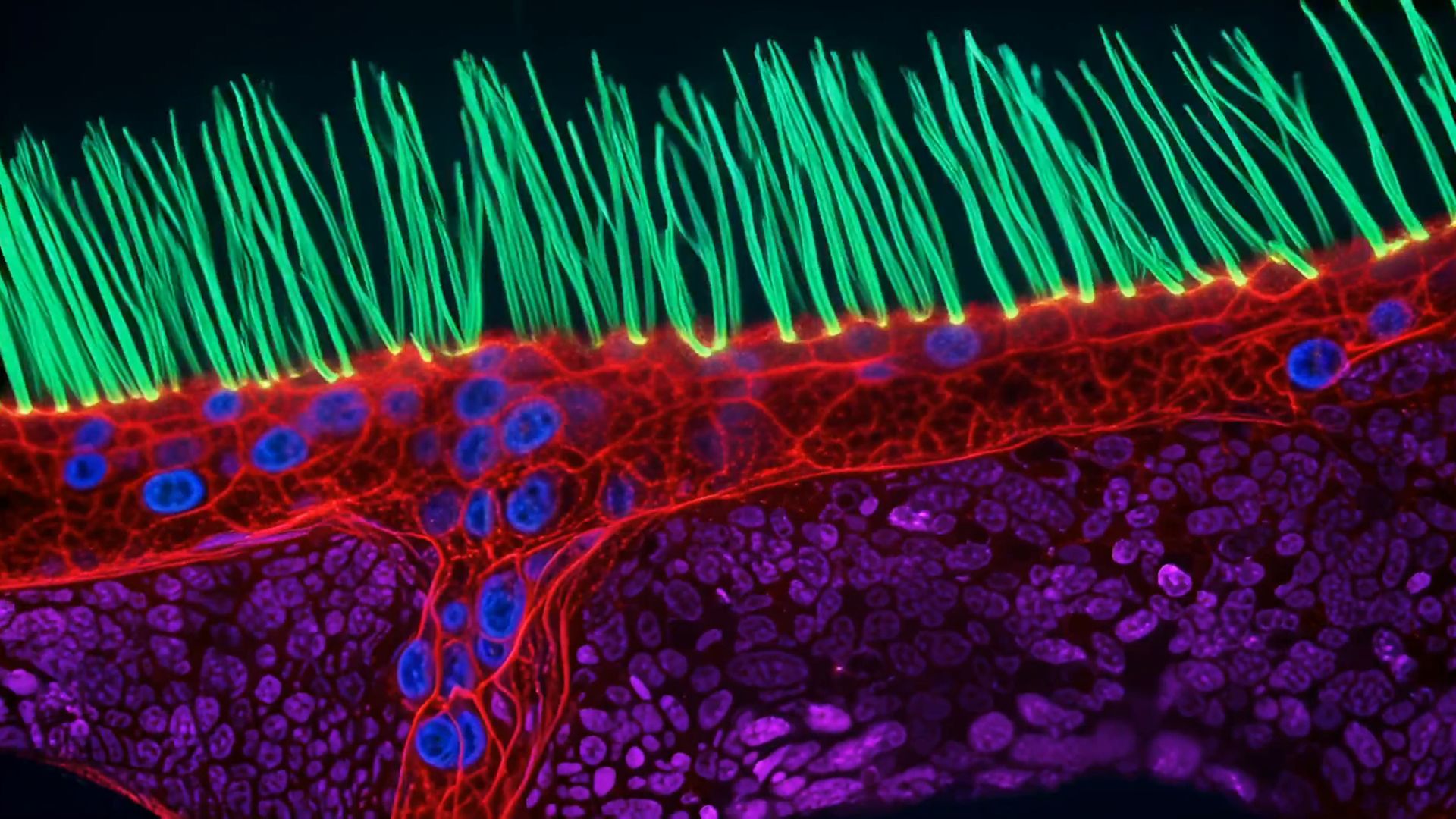
Winning video from Nikon microscope competition shows airway cells dancing in child with rare genetic disorder — Chinese student built imaging system to capture 'beautiful' cilia at 100x magnification
The Nikon Small World in Motion 2026 winners are here First prize goes to video of the cilia structures inside airways It's a 'beautiful and important' record of biology, says the winner The beauty in the world (and the universe) around us can be shown at the smallest scales as well as the largest ,
<![CDATA[ <article> <ul><li><strong>The Nikon Small World in Motion 2026 winners are here</strong></li><li><strong>First prize goes to video of the cilia structures inside airways</strong></li><li><strong>It's a 'beautiful and important' record of biology, says the winner</strong></li></ul><p>The beauty in the world (and the universe) around us can be shown at the smallest scales as well <a href="https://www.techradar.com/cameras/dslrs/nasa-reveals-generational-earthset-photo-taken-on-a-nikon-d5-the-decade-old-dslr-with-one-secret-weapon-over-modern-cameras-for-space-photography">as the largest</a>, as demonstrated by the annual Nikon Small World in Motion competition. The competition <a href="https://www.nikonsmallworld.com/" target="_blank">aims to showcase</a> "the beauty and complexity of life as seen through the light microscope", and the 2026 winners have now been announced.</p><p>First prize this year <a href="https://www.nikonsmallworld.com/galleries/2026-small-world-in-motion-competition/abnormal-beating-of-airway-cilia-from-a-child-with-primary-ciliary-dyskinesia-pcd" target="_blank">goes to a video</a> of airway cilia (tiny hair-like protein structures that stick out from some cells), captured at 100x magnification via diffractive super-resolution microscopy. The cilia are there to process mucus and carry waste out of the airways, though they're actually colorless — the green color here is artificially added.</p><p>There is a sad element to the story: these are the airways of a child with Primary Ciliary Dyskinesia (PCD), a rare genetic disorder that means the cilia don't work as they should, and mucus isn't as effectively cleared out. That's why these little structures are waving irregularly, rather than in one uniform, smooth movement.</p><p>The condition is a serious one, but usually manageable with the right treatment, and super-close-up videos like this one help scientists learn more about it. "To understand this disease, you need to watch the cilia through dozens of beat cycles, not just a still image," <a href="https://www.prnewswire.com/news-releases/16th-annual-nikon-small-world-in-motion-competition-winner-captures-abnormal-movement-of-airway-cilia-in-a-child-with-primary-ciliary-dyskinesia-302879601.html" target="_blank">says</a> Dr. Ning Xu, who captured the footage.</p><h2 id="microscopy-as-a-shared-language">Microscopy as a shared language</h2><div class="youtube-video" data-nosnippet ><div class="video-aspect-box"><iframe data-lazy-priority="high" data-lazy-src="https://www.youtube-nocookie.com/embed/Sz3V9398LEY" allowfullscreen></iframe></div></div><p>Xu is an optical engineering researcher who helps develop imaging systems for scientists to use. He's currently a fellow at the National University of Singapore, and has previously worked with researchers at Tsinghua University, the University of Cambridge, Beijing Children's Hospital, and the California Institute of Technology.</p><p>He's also <a href="https://www.nikonsmallworld.com/masters-of-microscopy/ning-xu-studying-disease-through-motion" target="_blank">apparently a big fan</a> of the Nikon Small World in Motion competition. "When people watch cilia beating, they immediately understand that something beautiful and important is happening inside us," says Xu. "I think this competition turns microscopy into a shared language."</p><p><a href="https://www.nikonsmallworld.com/galleries/2026-small-world-in-motion-competition/a-tiny-roundworm-and-a-single-celled-dileptus-explore-their-microscopic-world" target="_blank">Second place</a> in this year's competition was awarded to a video of a tiny roundworm and a single-cell organism interacting at 40x magnification, captured by Nguyen Nam Nhat. In <a href="https://www.nikonsmallworld.com/galleries/2026-small-world-in-motion-competition/jellyfish-larvae-suspended-in-water-droplets" target="_blank">third place</a> was Benedikt Pleyer's footage of jellyfish larvae suspended in water droplets, recorded at a magnification of 25x.</p><p>The <a href="https://www.nikonsmallworld.com/galleries/2026-small-world-in-motion-competition/synchronized-cell-division-in-neighboring-cells" target="_blank">fourth place</a> entry shows the process of synchronized cell division in neighboring cells, as captured by Dr. Andrew Moore at 63x magnification, while <a href="https://www.nikonsmallworld.com/galleries/2026-small-world-in-motion-competition/dynamics-of-mitochondria-and-chloroplasts-in-turtle-vine-leaf-cells" target="_blank">fifth place</a> in the 2026 awards was given to Dr. Patrick C. Hickey's 40x magnification recording of the cell power plants mitochondria interacting with chloroplasts in Turtle Vine leaf cells.</p> </article> ]]>